
 how-to
How to Check and Replace a Knitting Machine Sponge Bar
Last Updated: 25 October 2026
Quick Summary
A knitting machine sponge bar is a long strip of foam backed with a metal rail that sits in a channel at the front of the needle bed, holding every needle down against the bed as the carriage passes. Without that pressure, needles lift, the carriage can jam and stitches won’t form correctly.
- Check the needles along the full bed; they should be flat to the bed, not raised or spring if pushed down.
- Checking a sponge bar takes just a minute, no tools required and can save you hours of headaches!
- Replacing the bar is very simple and can be completed with just a few steps.
- Clean the retaining ba channel before inserting a new bar, to remove old fluff.
- Sponge bars are not universal; note your machine brand, model and gauge before ordering.
Table of Contents
- What a Knitting Machine Sponge Bar Does
- How to Check a Knitting Machine Sponge Bar
- How to Replace a Knitting Machine Sponge Bar
- Knitting Machine Needles Dropping: Causes and Fixes
- Sourcing the Right Sponge Bar for Your Machine
- Ordering a Sponge Bar and Keeping Your Machine Knitting
- Frequently Asked Questions
What a Knitting Machine Sponge Bar Does
A knitting machine sponge bar is a long strip of foam, backed with a metal rail, that sits in a channel at the front of the needle bed. Its job is to hold every needle down and back against the bed as the carriage passes over. Without that gentle pressure, needles lift, the carriage can jam and stitches won’t form correctly. This guide from Andee Knits explains what the sponge bar does, how to check it, and how to replace it when the foam has gone flat.
The sponge bar is the cheapest part on the machine and the one that causes the most grief. Learn to spot it early and you save yourself a repair bill or hours of frustration
Why the Sponge Bar Matters for Stitch Quality
Stitch quality depends on needle control. The sponge bar “retains” the needles, so the carriage can select and knit them cleanly. When the foam loses its spring, the needles sit loose and start to rise. The result is uneven stitches, dropped loops, and worst case scenario, a jammed carriage.
A healthy sponge bar gives you three things:
- Even needle pressure across the whole bed
- Reliable stitch formation
- Smooth carriage movement with no jamming
Fail on any of those and your tension swatch will lie to you.
How to Check a Knitting Machine Sponge Bar
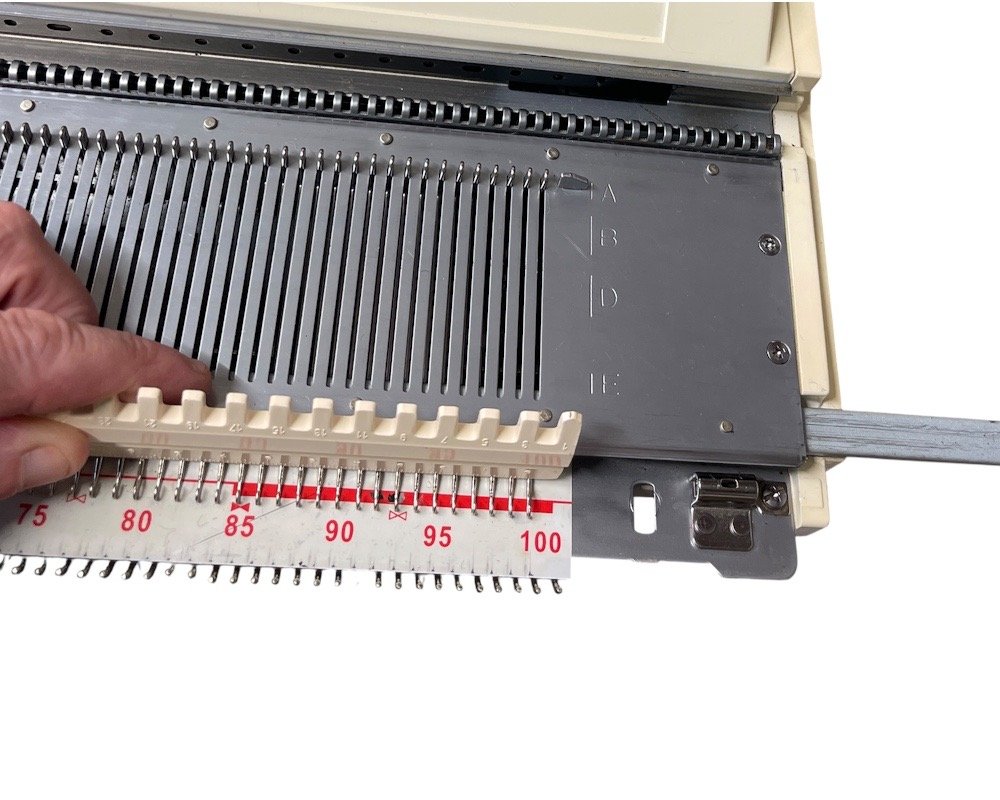
Checking a knitting machine sponge bar takes just a minutes and needs no tools. Slide the carriage to one end, look at the hook and latch at the front of the needles. The needles should be completely flat to the bed, press down on the front of the needles being careful not to hook your fingers…. it will hurt if you do! If the needles move up and down, the sponge bar is worn and needs replacing.
Work along the full length in sections, because wear is rarely even. Dropped stitch tools are available for fixing slipped stitches you find along the way. The middle of the bed usually goes first, since that is where most knitting happens.
Signs the Sponge Has Failed
Look for these warning signs before they turn into dropped stitches:
- Foam that has gone hard, flat, or powdery
- A sticky residue on the needle bed
- Needles that lift when you press the hook and latch end
- The carriage snagging or jamming
- Mispatterning when knitting any of the pattern stitches (problems are more rare when knitting stocking stitch)
Watch out: a sponge bar that has started to crumble will shed foam dust into the needle channels. That dust mixes with machine oil and turns into a gritty glue that can damage the surface of the bed and cause rust on the needles. Replace the sponge before it reaches that stage.
UK Health and Safety Executive guidance on safe use of hand tools and machinery
How to Replace a Knitting Machine Sponge Bar
Replacing a knitting machine sponge bar is a straightforward job you can do yourself.
- Pull the bar out of the channel, use a large flathead screwdriver or a thin block of wood to gently push in at one end, whilst pulling the other end out
- Use a long cat-tail cleaning brush, to push any fluff through the chanel and out of the other end, repeat until channel is clear
- The sponge bar must be inserted foam-side down over the top of the needles, hold the front of the needles flat whilst simultaneously inserting the new sponge bar
- Ensure the bar goes through and finishes at the other end of the channel and does not work its way inside the needle bed
Step-by-step process of removing a worn knitting machine sponge bar from the needle bed for replacement.
Here is how we would do it:
- Remove the carriage off of the bed.
- Using a large flathead screwdriver or wooden block, gently push one end of the old sponge bar until enough is out at the other end to pull.
- Insert a long cat-tail brush into the retaining bar channel and remove old fluff.
- Get the new sponge bar and hold metal side up and sponge side down.
- Using a flat needle pusher, hold the needles flat to the bed and insert the sponge bar over the top of the needles.
- Work along the bed as in step 5 until the bar is fully through.
Expected result: the carriage should glide with light, even resistance and no snagging.
Cleaning Before You Replace
Cleaning is the step most people skip, and it is the one that matters most. Brush out every retaining bar channel with a cat-tail brush. Wipe the bed with a lint-free cloth and a little surgical spirit. Let it dry fully before the new bar goes in.
Replacing the bar is a six-step job that takes about twenty minutes.
Step | What to do |
|---|---|
1 | Remove the carriage off of the bed |
2 | Using a large flathead screwdriver or wooden block, gently push one end of the old sponge bar until enough is out at the other end to pull |
3 | Insert a long cat-tail brush into the retaining bar channel and remove old fluff. |
4 | Get the new sponge bar and hold metal side up and sponge side down |
5 | Using a flat needle pusher, hold the needles flat to the bed and insert the sponge bar over the top of the needles |
6 | Work along the bed as in step 5 until the bar is fully through |
Knitting Machine Needles Dropping: Causes and Fixes
Dropped stitches usually trace back to one of four causes: a worn sponge bar, bent or blunt needles, incorrect tension, or a misaligned sinker plate / arm. Check the needles and fix the sponge first, because it is the quickest and easiest check. If stitches still drop after that, check tension and then sinker plate / arm.
Look for bent hooks, sticky latches, and worn butts. A needle that will not slide freely in its channel is a needle that will drop stitches. Replace them in sets rather than singly where you can.
If your inspection points to worn needles rather than foam, you can order replacement needles to get the right fit for your bed.
Sourcing the Right Sponge Bar for Your Machine
Sponge bars are not universal. Length, foam thickness, and the shape of the retaining rail differ between brands and between gauge sizes. An incorrect bar will exert incorrect needle pressure causing problems with your knitting.
Before you order, note two things:
- The machine brand and model number
- The gauge, such as standard, mid, or chunky
If you are unsure what fits an older machine, ask before you buy. At Andee Knits we stock parts for Silver Reed, Knitmaster and Brother machines and can match a bar to your make / model. As an authorised stockist, we can confirm compatibility rather than guess at it.
UK Intellectual Property Office guidance on buying genuine branded spare parts
Ordering a Sponge Bar and Keeping Your Machine Knitting
Sponge bars are a consumable, not a lifetime part. Most machines will need one every 6-12 months with regular use, and more often if the machine lives in a warm, dry room.
Always order a “fresh” sponge bar when you need it as foam deteriorates over time, even when not being used in a machine.
Our advice is simple: check the sponge every time you change a project, and replace it at the first sign of flatness. That single habit prevents most knitting problems before they start.
At Andee Knits we have supplied and serviced knitting machines since 2005. We keep sponge bars, needles, and spares in stock, ship free on orders over £40, and offer 30 day returns. If you are not sure which part you need, our team will help you work it out.
Frequently Asked Questions
What does a knitting machine sponge bar do?
The knitting machine sponge bar sits in the needle bed and presses down on the needles, keeping them level and in their slots as the carriage passes over. Without that gentle downward pressure, needles can lift, jam or drop stitches, and the fabric comes out uneven. It is a consumable part, so the foam compresses and perishes over time and needs checking regularly, especially on older or refurbished machines.
How do I know if my knitting machine sponge bar needs replacing?
Run your finger along the foam: if it feels flat, crumbly, sticky or has sunk below the metal housing, it has failed. Other clues are needles sitting proud of the bed, frequent dropped stitches, or the carriage feeling stiff or catching. Compare the foam height across the full length of the bar, because wear is often worse in the middle where most knitting happens.
Can a worn sponge bar cause knitting machine needles to drop?
Yes. A collapsed sponge bar no longer holds the needles down, so they can rise out of position as the carriage passes and miss stitches or drop entirely. If you are troubleshooting knitting machine needles dropping, check the sponge bar before blaming the needles themselves. Replace a flattened bar and re-seat any bent needles, and most dropping problems clear up.
Are sponge bars interchangeable between knitting machine models?
No. Sponge bars are cut to the width and profile of a specific needle bed, so a bar for one model will not fit another. Always match the bar to your machine's make and model, and if you are unsure which one you need, check with a specialist stockist who can confirm compatibility before you order.
A flat sponge bar can stall a whole project, and guessing at the right replacement part wastes time. Andee Knits stocks sponge bars and needles for Silver Reed, Brother, and Knitmaster machines, with expert advice on compatibility, in-house servicing, and fast despatch. Get started with Andee Knits and keep your machine knitting smoothly.
